Notes on what is kept, what is passed down, and what quietly shapes a home.
From the Journal
A Table for Two
A table for two sounds smaller than it is.
We talk a lot about manners like they’re a checklist.
Say please.
Say thank you.
Look up when someone speaks.
And those things matter.
But underneath all of it, there’s a quieter lesson that doesn’t translate well into instruction.
How to be present with another person.
And more than that—how to consider them.
We take them on dates.
Not in any formal sense. Nothing elaborate or scheduled.
Just small pockets of time where the attention shifts.
Sometimes it’s big.
A hockey game with their dad, loud and fast and full of things to look at so no one has to carry the conversation too hard.
An afternoon painting pottery, where the pace slows whether you like it or not.
Sometimes it’s smaller.
Ice cream that melts faster than they can eat it.
A drive down to the fish shack by the water, where the food comes out in paper trays and everything tastes a little like salt and sunscreen.
And sometimes, it’s just a table.
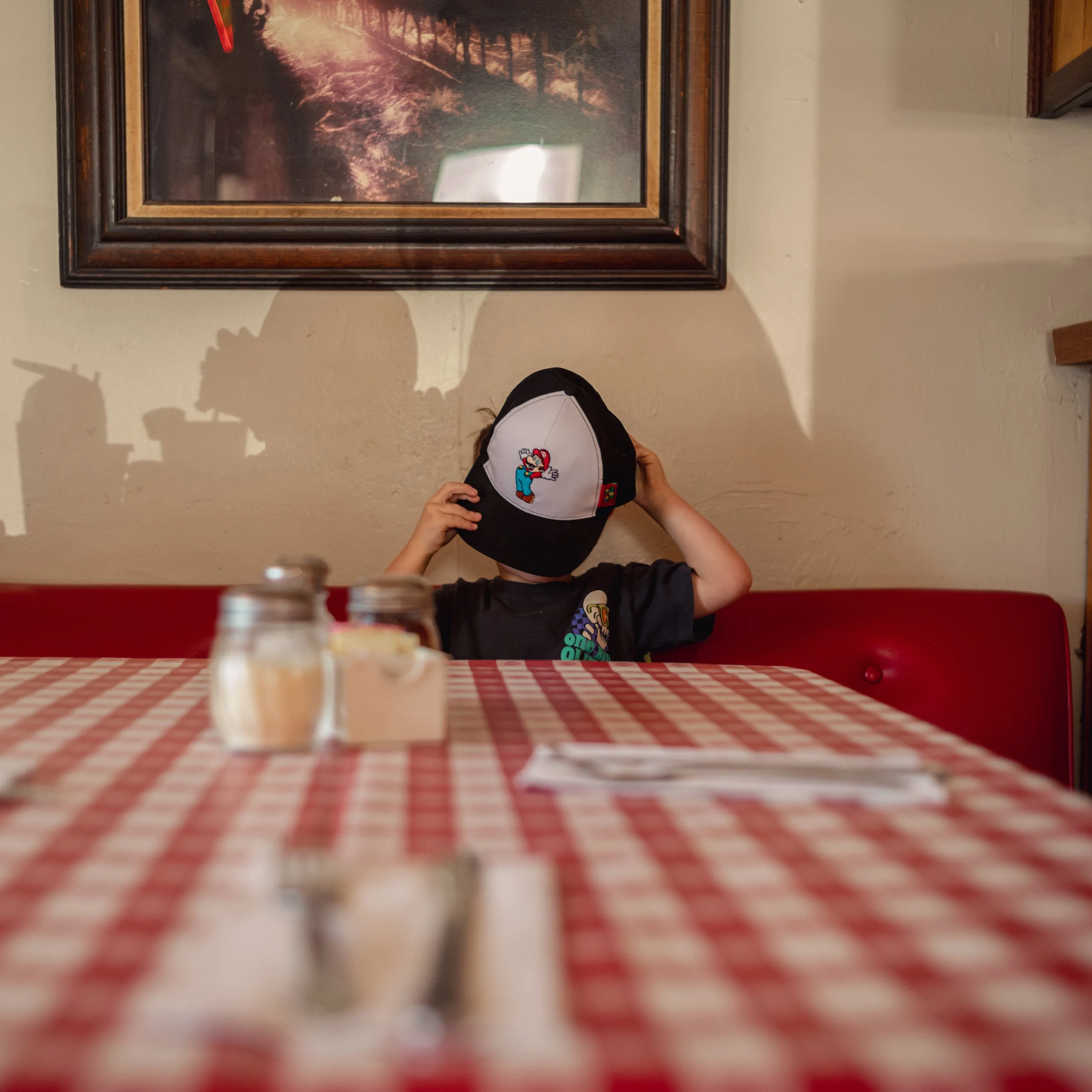
I remember sitting across from one of them, not that long ago.
He had already finished eating.
I was still halfway through mine.
And you could see it—the pull to get up, to move, to go find something else more interesting than sitting there with me.
He shifted.
Looked past me.
Started to slide out of the booth.
“Sit,” I said, not sharp, just steady.
Not as a command. As a reminder.
Stay with me.
The details change depending on the child.
That’s part of the point.
Because what we’re really trying to teach them is not just how to sit across from someone—
but how to think about the person sitting there.
What they might enjoy.
What would make them feel seen.
What kind of time would feel like it was chosen for them.
From the outside, it can look like a simple outing.
But for a child, it’s a kind of practice.
To stay in the conversation.
To listen when they’d rather talk.
To ask questions that aren’t about themselves.
To resist the quiet urge to leave the moment the second it stops entertaining them.
We don’t give speeches about this.
We’re not raising diplomats.
We just keep showing up.
Different tables. Different days. Different children.
Letting them feel the weight of it in real time.
And slowly, over time, they begin to understand something we could never quite put into words:
That being with someone is one thing.
But learning how to be for them—
to sit, to stay, to pay attention even when it would be easier not to—
is a skill.
And like anything worth having,
it’s learned the slow way.
Across a table,
long after they’ve finished eating.
Musical beds
There is a version of the night that begins with order.
Teeth brushed, water cups filled, lights dimmed just enough to feel like we tried.
Everyone tucked into their own bed, their own space, their own small corner of the house.
It looks right.
It feels finished.
We close doors halfway — not all the way, never all the way — and step back into the hallway like we’ve done our job.
And for a moment, we have.
But sometime between then and morning, the house rearranges itself.
Quietly. Without permission.
One by one, they begin to migrate.
A set of footsteps you barely register.
The soft push of a door.
The weight of a small body at the bedside — not asking, just waiting.
And without fully waking, you lift the blanket.
We don’t talk about it in the morning like it’s a decision that was made.
No one announces it.
But if you were to map it out, it would look like a game of musical chairs no one agreed to play.
The one who started in his twin bed ends up sideways across ours.
Another, who swore he wasn’t scared anymore, appears sometime after midnight, pressing close like it was always the plan.
By morning, no one is where they began.
No one except my husband.
He stays exactly where he fell asleep.
A fixed point in a house that refuses to hold its shape.
There’s something almost impressive about it.
Or maybe just deeply practical.
While the rest of us drift and shift and negotiate space in the dark, he remains — unmoved, undisturbed, somehow untouched by the quiet reshuffling happening around him.
Unaffected by the small, nightly collapse of everyone else’s good intentions.
There is a version of me, earlier in the evening, that means it when I say everyone sleeps in their own bed.
I believe it when I say it.
I say it like it’s a rule.
And then there is the version of me at 2:17 in the morning.
Half asleep. No patience for philosophy.
Lifting the covers without a word, making room without keeping score.
Not because I’ve changed my mind.
Just because, in that hour, it doesn’t feel like something worth holding the line on.
It would be easy to call it inconsistency.
To say we should be stricter.
More structured.
But the truth is, nothing about it feels chaotic.
It feels… instinctive.
Like everyone, in their most unguarded state, is just finding their way back to where they feel safe.
During the day, we’re very clear about where everyone belongs.
Beds assigned.
Rooms defined.
Space divided.
But at night, none of it seems to matter quite as much.
The house softens.
The edges blur.
And we let it.
By morning, it always looks a little ridiculous.
Limbs everywhere.
Blankets twisted.
Someone halfway off the edge like they ran out of real estate hours ago and just committed to it.
We laugh about it.
We stretch and untangle and send everyone back to where they’re supposed to be.
Order, restored.
But only for a while.
Because we’ll do it all again that night.
We’ll tuck everyone in.
We’ll mean it.
We’ll believe it.
And then, slowly, quietly, the house will rearrange itself.
One day, it won’t.
Everyone will stay exactly where they’re put.
No footsteps in the hallway.
No small bodies waiting at the bedside.
No quiet negotiations in the dark.
The order we practiced for will finally arrive.
And I have a feeling
we won’t like it nearly as much as we thought we would.
The Quiet Promotion
Some childhood promotions happen quietly.
There comes a moment when the job changes.
Yesterday you were holding their hand in line.
Today you’re sitting in the car while they walk through the door alone, clutching the folded bill you handed them in the parking lot.
The baby is asleep in the back seat, the soft rhythm of breathing filling the quiet space of the car.
The instructions are simple.
Go in.
Order the donuts we talked about.
Come right back out.
We’ve already reviewed the plan in the car.
What to say.
How many donuts.
Where to stand.
It’s not a complicated job.
But it is a new one.
Inside the shop, adults are ordering coffee and moving through the morning like they always do. Behind the counter someone slides pink boxes across the glass with the quiet efficiency of a place that has done this a thousand times before.
From the parking lot you can see them through the window, shifting their weight from one foot to the other, rehearsing the order quietly to themselves.
When their turn comes, they stretch up slightly toward the counter and place the folded bill down with a seriousness usually reserved for much larger transactions.
You try not to stare too obviously.
Parents learn early that too much watching can make a child suddenly unsure of themselves.
So you glance down at the sleeping baby, then back toward the window just in time to see the exchange happen.
Money.
Donuts.
A box.
Then the door opens again.
They emerge carrying the prize — a pink donut box held carefully in both hands like something important.
Mission accomplished.
Mostly.
Because when the lid opens in the car, there are… a few more donuts than originally discussed.
The job was done.
Technically.
But childhood negotiations with pastries are complicated things.
Still, the important part happened.
Money changed hands.
An order was placed.
A small promise was kept.
Which, in the grand hierarchy of childhood responsibilities, ranks somewhere between remembering your library book and not losing the house key.
But it matters.
Because somewhere along the way, a child receives a quiet promotion.
A little more responsibility.
A little more trust.
Not with speeches or ceremony.
Just a folded bill in their pocket,
and a pink donut box carried carefully out the door.
With, as it turns out,
a few extra donuts inside.
Which is exactly the sort of executive decision you might expect from someone newly promoted.
The Quiet Act of Noticing
Most mornings in our house begin slowly.
My oldest usually makes it downstairs first and enjoys a few quiet minutes of full authority over the television and the remote before anyone else can weigh in.
Not long after, my middle follows.
One of his responsibilities now is turning on the coffee when he heads downstairs.
The house is still waking up at that point.
The dogs stretch.
Someone wanders into the kitchen half awake.
And the smell of coffee begins working its way through the house.
Children don’t realize it yet, but they’re already learning one of the most important skills a home can teach.
The quiet act of noticing.
Noticing flowers growing along a sidewalk.
Noticing when a brother suddenly goes quiet.
Noticing when the dog has been pacing by the door long before anyone else realizes he needs to go out.
Or noticing that the trash is full — a detail that somehow escapes everyone’s attention until it can no longer be politely ignored.
Children don’t start out noticing much beyond their own world.
They notice hunger.
Excitement.
The toy someone else is holding.
They do not, for example, notice the dog pacing by the door, the laundry multiplying in the hallway, or the fact that someone has already asked them three times to put their shoes away.
But slowly their awareness begins to widen.
They begin to see other people.
Noticing that someone else is nervous even when they themselves are excited.
Noticing when a sibling suddenly grows quiet.
Noticing when something small needs doing before someone has to ask.
These things seem small.
But they are the beginning of social awareness.
You can’t care about what you don’t notice.
When I think about where I learned this skill, I realize it was the women in my life who taught me first.
My grandmother helping my mother around the house — because with seven children there was always something that needed doing.
My mother somehow remembering each of our small preferences — favorite chocolate bars, how we liked our eggs in the morning.
My sisters noticing when I wore a new shirt or did my hair differently.
Little acknowledgments that quietly said:
I see you.
Later I began to notice the same skill in my husband.
Sometimes he notices a shift in my mood before I’ve even decided what my mood is.
It usually begins with a joke — the kind that makes the boys laugh just enough to break whatever storm cloud was gathering in the room.
And then, almost casually, he steps in and changes the energy of the moment.
Redirecting the boys.
Lightening the atmosphere.
Restoring the rhythm of the house.
Noticing isn’t only a kind of care carried by women.
Men have an enormous role in it too.
Children are always watching.
They watch how adults read a room.
How they respond to someone’s frustration.
How they quietly step in when something needs tending.
And slowly, almost without realizing it, they begin to do the same.
In our house there is also a lot of coffee talk.
One sip before questions begin.
Asking for a warm-up halfway through the morning.
Stopping for coffee before an errand.
The boys notice this.
They also occasionally ask for a sip.
My husband takes his black, which usually leads to immediate regret.
Mine is creamy with just a touch of sweetness, which makes them curious enough to try again.
And when my mother-in-law visits, she takes her coffee about eighty percent cream and twenty percent coffee — which the boys have correctly identified as essentially dessert.
Children notice rituals long before they understand them.
The hope is that one day they will move through the world noticing the people around them.
Noticing when someone feels nervous.
Noticing when someone needs help.
Noticing the small things that make a person feel seen.
And maybe someday, many years from now, one of them will hand his wife a cup of coffee.
Made exactly the way she likes it.
Not because she asked.
Just because he noticed.
Which, when you think about it, is how most good relationships begin.
Small Fictions
A little mischief in life, just to keep things interesting.
There are things I tell my kids that aren’t entirely true.
Not big things.
Not the kind that matter later.
Just small ones.
Like how I can always tell when they’re lying — because their eyes change color when they do.
They still pause when I say it.
You can see it — the split second where they consider whether it might be real.
A quick blink.
A glance away.
A hand that moves just slightly closer to their face, like they might cover it if they could.
And sometimes, that’s enough.
The truth comes out before it has time to settle into something else.
I know what I’m doing.
I know the irony of it — telling a lie to catch one.
It’s not lost on me.
But there are moments in parenting where the clean, honest explanation just… doesn’t work.
Where “because it’s the right thing to do” feels thin against whatever impulse they’re trying to outrun.
And in those moments, something a little more immediate, a little more convincing, tends to win.
Parenting, at times, feels less like instruction and more like theater.
A little stagecraft in the service of raising decent humans.
We do this more than we admit.
We say carrots help you see in the dark.
We warn that the ice cream truck only plays music when it’s out of ice cream.
We create a world that bends just slightly, enough to guide them where they’re not yet able to guide themselves.
Not forever.
Just for now.
Children already live in a kind of half-magic.
Tooth Fairies.
Santa.
The quiet belief that the world is paying attention to them in ways it probably isn’t.
We don’t create that entirely.
But we do… manage it.
Shape it.
Nudge it in directions that make our jobs a little easier, and their choices a little better.
It would be nice if everything about parenting was clean.
If every lesson could be taught honestly, directly, without any need for embellishment.
But it isn’t.
Some things are learned through experience.
Some through repetition.
And some, at least in the beginning, through a well-placed fiction.
One day, they’ll figure it out.
They’ll realize their eyes never changed color.
That I couldn’t actually tell, at least not in the way I said I could.
And maybe they’ll see the trick in it.
But by then, hopefully, they won’t need it anymore.
The Boys’ Room
Childhood leaves evidence everywhere.
Two twin beds sit a few feet apart in the boys’ room, each with the same green-and-white quilt—though they rarely stay neatly folded for long.
By the end of most days the floor is scattered with toy cars, socks, and the small debris of childhood.
Lamps glow on either side of the beds, and sometime after the lights go out the whispering begins.
The boys share this room.
And without realizing it, they’re learning something important here: how to live with another person.
Before the lights go out we usually read for a while.
Some nights we’re laughing our way through Frog and Toad. Other nights the room grows quiet as we slowly make our way through Harry Potter, or take a quick adventure with the Magic Tree House before closing the book.
Of course, this all sounds very peaceful when written down.
In reality there are usually at least three interruptions, someone suddenly remembering a critical detail from earlier in the day, and a last-minute negotiation over who gets to choose the book that night.
But eventually the story ends.
Before turning out the lights I ask them one last question.
“Tell me the three best parts of your day.”
Sometimes the answers are small: a good recess game, a funny moment at dinner, a Lego creation that finally worked.
Other nights they think a little longer before answering.
It’s a simple habit, but it sends them to sleep looking back over the day for the good in it before letting it go.
Some nights, when I’m trying to muscle through the final meltdown of the day, I glance up at the sign on their wall that reads These Are the Good Old Days and remember—somewhat inconveniently—that it’s telling the truth.
Then the lamps click off.
And the whispering begins.
In that small room, between the twin beds and the quiet negotiations that happen after dark, the boys are learning something that’s hard to teach directly.
Sharing a room means learning that another person exists beside you—with their own blankets, their own books, and their own need for quiet when you’d rather keep talking.
Some nights that lesson lands gently.
Other nights it arrives a little louder.
But either way, the boys are slowly learning the small diplomacy of sharing a life.
Modern homes often assume that children should each have their own rooms, their own private corners of the house.
And one day the boys probably will.
But for now there’s something quietly valuable about this shared space.
In this room they’re learning patience, compromise, and the simple awareness that comfort belongs to more than just themselves.
Years from now they’ll have their own rooms, their own homes, their own lives that stretch far beyond this one small space.
But for now there are two twin beds, a floor scattered with the remains of the day’s adventures, and the low murmur of voices long after the lamps are switched off.
And somewhere in that quiet room, long after bedtime, the whispering continues.
The Culture of a Table
The culture of a home is built in small rituals repeated every day.
There is a particular moment in the late afternoon when the house begins its quiet shift toward evening.
The light softens. The kitchen starts making its familiar sounds again. And the dining table—so recently abandoned to the debris of the day—begins its slow transformation.
A bowl pushed aside.
School papers stacked.
Crayons returned to their jar.
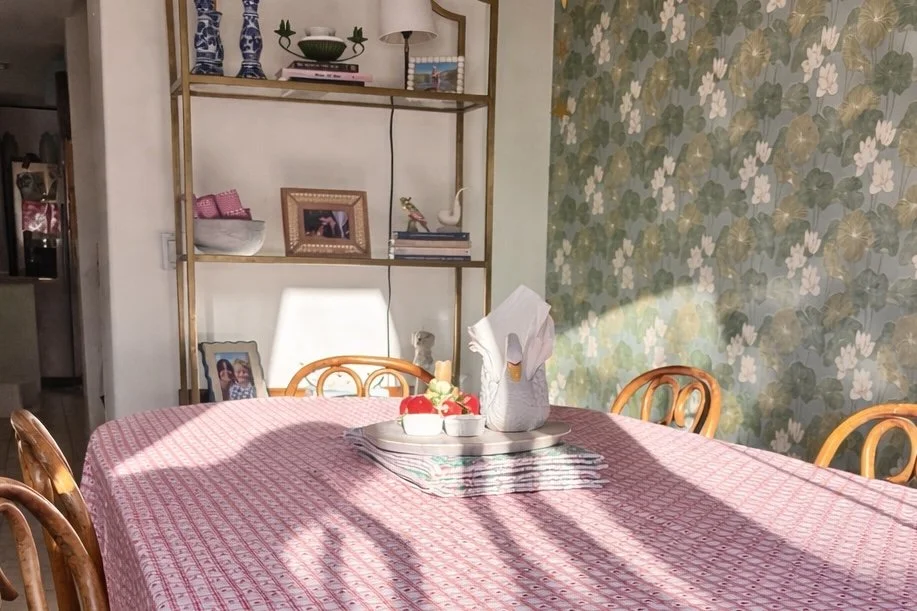
Soon enough it will be a dinner table again.
In our home, the table may be the most faithful object we own. It asks very little of us, yet bears witness to nearly everything.
Quick breakfasts before school.
The chaos of afternoon crafts.
A loaf of bread cooling on the counter while someone inevitably tears off a piece before it’s ready.
It is constant, and yet it is never the same twice.
Ours sits beneath cheerful wallpaper that wasn’t designed with three boys in mind. Some days there’s a bright tablecloth spread across it. Other days it’s bare except for the remains of the afternoon— paper chain scraps, crayons rolling toward the edge, someone’s forgotten glass of milk.
The table is where life gathers in small layers.
Jam on a sleeve. Someone talking with their mouth full. Another trying to remember if they’re supposed to keep elbows off the table — or if that rule has quietly disappeared somewhere along the way.
Culture, I’ve come to believe, isn’t something distant or grand. It’s something practiced quietly in ordinary places—most often around a table.
A cultured home isn’t a perfect home. It’s just a home where everyday life is handled with a little care.
Candles lit even when dinner is simple. Napkins unfolded even if someone spills immediately.
Children expected to participate, though they are still very much allowed to be children. It isn’t refinement for refinement’s sake.
It’s practice—gentle practice—in how to live with other people.
For a long time, the table was where these lessons unfolded naturally.
Children watched adults pass dishes before serving themselves. They learned that meals belonged to everyone gathered there, not just the one who cooked them.
Somewhere along the way, many of us lost that rhythm.
Modern life scatters people into separate corners.
Meals eaten quickly. Plates balanced on laps.
A quiet feeling that we’re all doing our best, but maybe missing something we can’t quite name. People often say raising children used to take a village.
And it did.
But villages weren’t just neighbors and grandparents.
They were tables.
Places where stories were told often enough to become family history. Where guests showed up with very little notice and somehow there was always room.
Where children sat nearby, listening to conversations that weren’t entirely meant for them until one day they realized they had grown into them.
These days, many of us live without that kind of village.
But the hopeful thing is that villages aren’t only something we inherit.
Sometimes they’re something we build.
Often it begins with a table.
Not a particularly grand one. Not even a tidy one most days. Just a place people gather regularly enough that it starts to mean something.
In our house, the table changes its purpose several times before the day is done. In the morning it holds bowls of cereal and the urgency of getting everyone out the door. By midday it may be buried in pencils, spelling worksheets, or whatever paper creation someone has decided must immediately hang from the ceiling. By evening, it gathers us back together again.
There are three boys at our table, each arriving with a story they’re determined to tell first. No one is quietly listening. Everyone is talking at once. Someone is halfway out of their chair reenacting something that happened earlier that day.
Bread disappears quickly.
Milk occasionally spills.
And somehow dinner still happens.
Some nights feel almost ceremonial. Candles lit. Plates passed. A moment where the day settles down and everyone seems content to linger a little longer. Other nights are louder. Someone refuses vegetables with great conviction. Someone else insists they’ve already eaten enough after three bites.
Both count.
Because culture in a home isn’t built from perfection. It’s built from repetition. From the simple act of showing up again tomorrow. Over time, the table begins to hold something larger than the meals themselves. It becomes a quiet record of a family’s life. Birthdays celebrated. Bad days softened with soup and bread. Conversations that stretch long past the last plate being cleared.
Years from now, my children probably won’t remember much of what was actually served here. But I suspect they’ll remember the feeling of it. The light above the table. The sound of chairs scraping across the floor. The sense that everyone belonged in the same place.
And maybe that’s the real work of a table.
Not just feeding the people who gather there, but quietly shaping the kind of homes they’ll one day build themselves.