The Culture of a Table
The culture of a home is built in small rituals repeated every day.
There is a particular moment in the late afternoon when the house begins its quiet shift toward evening.
The light softens. The kitchen starts making its familiar sounds again. And the dining table—so recently abandoned to the debris of the day—begins its slow transformation.
A bowl pushed aside.
School papers stacked.
Crayons returned to their jar.
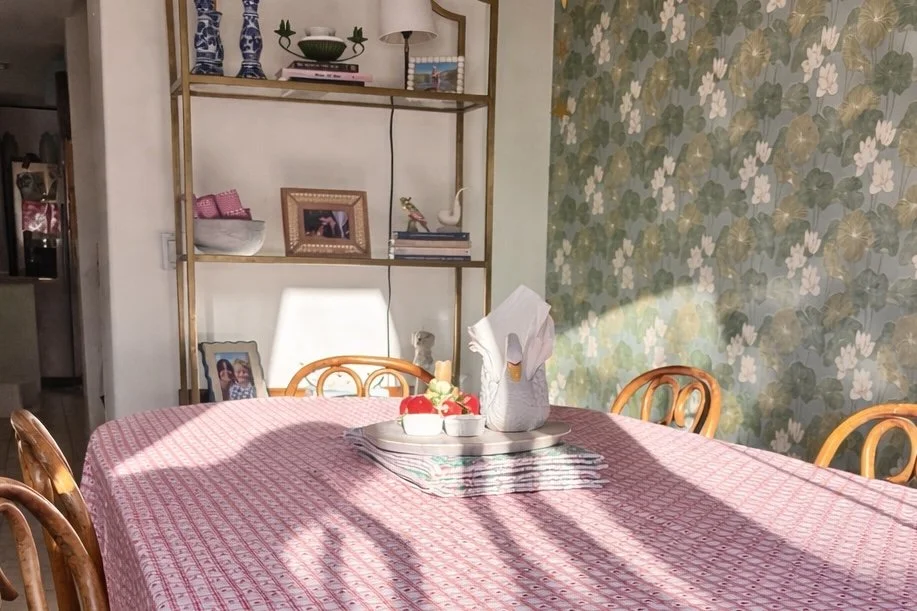
Soon enough it will be a dinner table again.
In our home, the table may be the most faithful object we own. It asks very little of us, yet bears witness to nearly everything.
Quick breakfasts before school.
The chaos of afternoon crafts.
A loaf of bread cooling on the counter while someone inevitably tears off a piece before it’s ready.
It is constant, and yet it is never the same twice.
Ours sits beneath cheerful wallpaper that wasn’t designed with three boys in mind. Some days there’s a bright tablecloth spread across it. Other days it’s bare except for the remains of the afternoon— paper chain scraps, crayons rolling toward the edge, someone’s forgotten glass of milk.
The table is where life gathers in small layers.
Jam on a sleeve. Someone talking with their mouth full. Another trying to remember if they’re supposed to keep elbows off the table — or if that rule has quietly disappeared somewhere along the way.
Culture, I’ve come to believe, isn’t something distant or grand. It’s something practiced quietly in ordinary places—most often around a table.
A cultured home isn’t a perfect home. It’s just a home where everyday life is handled with a little care.
Candles lit even when dinner is simple. Napkins unfolded even if someone spills immediately.
Children expected to participate, though they are still very much allowed to be children. It isn’t refinement for refinement’s sake.
It’s practice—gentle practice—in how to live with other people.
For a long time, the table was where these lessons unfolded naturally.
Children watched adults pass dishes before serving themselves. They learned that meals belonged to everyone gathered there, not just the one who cooked them.
Somewhere along the way, many of us lost that rhythm.
Modern life scatters people into separate corners.
Meals eaten quickly. Plates balanced on laps.
A quiet feeling that we’re all doing our best, but maybe missing something we can’t quite name. People often say raising children used to take a village.
And it did.
But villages weren’t just neighbors and grandparents.
They were tables.
Places where stories were told often enough to become family history. Where guests showed up with very little notice and somehow there was always room.
Where children sat nearby, listening to conversations that weren’t entirely meant for them until one day they realized they had grown into them.
These days, many of us live without that kind of village.
But the hopeful thing is that villages aren’t only something we inherit.
Sometimes they’re something we build.
Often it begins with a table.
Not a particularly grand one. Not even a tidy one most days. Just a place people gather regularly enough that it starts to mean something.
In our house, the table changes its purpose several times before the day is done. In the morning it holds bowls of cereal and the urgency of getting everyone out the door. By midday it may be buried in pencils, spelling worksheets, or whatever paper creation someone has decided must immediately hang from the ceiling. By evening, it gathers us back together again.
There are three boys at our table, each arriving with a story they’re determined to tell first. No one is quietly listening. Everyone is talking at once. Someone is halfway out of their chair reenacting something that happened earlier that day.
Bread disappears quickly.
Milk occasionally spills.
And somehow dinner still happens.
Some nights feel almost ceremonial. Candles lit. Plates passed. A moment where the day settles down and everyone seems content to linger a little longer. Other nights are louder. Someone refuses vegetables with great conviction. Someone else insists they’ve already eaten enough after three bites.
Both count.
Because culture in a home isn’t built from perfection. It’s built from repetition. From the simple act of showing up again tomorrow. Over time, the table begins to hold something larger than the meals themselves. It becomes a quiet record of a family’s life. Birthdays celebrated. Bad days softened with soup and bread. Conversations that stretch long past the last plate being cleared.
Years from now, my children probably won’t remember much of what was actually served here. But I suspect they’ll remember the feeling of it. The light above the table. The sound of chairs scraping across the floor. The sense that everyone belonged in the same place.
And maybe that’s the real work of a table.
Not just feeding the people who gather there, but quietly shaping the kind of homes they’ll one day build themselves.