From the Kitchen
Some meals feed more than hunger.
Banana-Chocolate Streusel Muffins
Proof that neglect has its rewards
(Adapted from Baking at République)
There are recipes you make because they’re trending, and then there are recipes that quietly become part of the furniture of your kitchen.
This one is the latter.
I’ve tried enough banana muffins over the years to stop looking. These are tender without being cakey, rich without feeling heavy, and the dark chocolate keeps them from wandering into cupcake territory. They’re the muffins I make when bananas have crossed the point of no return, when someone needs something tucked into a lunchbox, or when the kitchen feels like it ought to smell like brown sugar and cinnamon.
Like most recipes that stick around long enough, this one has changed a little over time.
I fold a little sourdough discard into the batter because The Mother always seems to have an opinion. The fresh banana slices on top became freeze-dried ones after I realized they kept the centers from staying damp. And I’ve quietly ignored the recipe’s suggestion to make enough streusel for two lifetimes.
Recipes should earn their place in a kitchen.
This one has.
⸻
Banana-Chocolate Streusel Muffins
Makes 12 muffins
Streusel (half batch)
70 g all-purpose flour
⅛ tsp ground cinnamon
180 g packed light brown sugar
55 g unsalted butter, cold and cubed
Rub together with your fingertips until pea-sized clumps form. Set aside.
⸻
Muffins
210 g all-purpose flour
1 tsp baking soda
½ tsp fine sea salt
¼ tsp ground cinnamon
2 eggs
205–210 g granulated sugar
85 ml avocado oil
30 g sour cream
10 ml vanilla extract
100 g sourdough discard (100% hydration)
340 g very ripe bananas, mashed (about 3–4)
80 g dark chocolate (55–64%), chopped
12 freeze-dried banana slices
⸻
Method
Heat oven to 350°F (175°C). Grease or line a 12-cup muffin tin.
Make the streusel by rubbing together the flour, cinnamon, brown sugar, and butter until crumbly.
Whisk together the flour, baking soda, salt, and cinnamon.
Beat the eggs and sugar until pale and fluffy, about 2 minutes.
Slowly drizzle in the oil.
Mix in the sour cream, vanilla, and sourdough discard.
Fold in the dry ingredients just until no flour remains.
Fold in the mashed bananas, then the chopped chocolate.
Divide between the muffin cups (about 75 g batter each).
Top generously with streusel.
Bake for 12–14 minutes.
Quickly open the oven and gently press one freeze-dried banana slice into the top of each muffin.
Return to the oven and bake another 7–9 minutes, until a tester comes out clean.
Cool for a few minutes before transferring to a rack.
Notes
Sourdough discard: Stir in 100 g of 100% hydration discard with the sour cream and vanilla. Reduce the oil to 85 ml and the sugar to about 205–210 g.
Banana topping: Skip the fresh banana slices. Bake the muffins for about 12–14 minutes, then gently press a freeze-dried banana slice into each muffin before finishing the bake.
Streusel: Half the recipe is plenty for one batch. Your freezer—and your future self—will thank you.
Chocolate: Hand-chopped dark chocolate creates little flecks and larger pools that melt differently. It’s worth the extra minute.
⸻
From My Pantry
I almost never make these exactly as written anymore. A little sourdough discard finds its way into the batter because I always have some to use, and freeze-dried banana slices solved the perpetually damp spot that fresh bananas left in the center. Neither change is dramatic. They just make a good recipe quietly better.
Pantry: Pickled Red Onions
Sharp, bright, and endlessly useful.
There’s always a jar of something sharp in a good kitchen.
Not loud. Not complicated. Just sitting there—doing quiet work.
Pickled red onions are that jar.
They cut through richness, wake up leftovers, and make even the most thrown-together meal feel like it had a plan. Tacos, eggs, grain bowls, roast chicken straight from the fridge—suddenly it all lands a little brighter.
This is the version I come back to. Simple, balanced, and just aggressive enough to matter.
Ingredients
• 1 large red onion ( 250–300 g), very thinly sliced
• 120 g red wine vinegar
• 120 g water
• 25 g granulated sugar
• 8 g kosher salt
Optional, but worth it :
• pinch red pepper flakes
• strip of orange peel
• 1 small garlic clove, lightly crushed
Method
1. Slice the onions thin
As thin as you can get them. This is the difference between “good” and “you keep reaching into the jar.”
2. Make the brine
In a small saucepan, combine vinegar, water, sugar, and salt.
Heat just until everything dissolves—don’t boil it into submission.
3. Pour and press
Place onions in a jar or bowl. Pour the warm brine over the top.
Press them down so everything is submerged.
4. Let it sit
They’re ready in about 30 minutes, but better after a few hours.
Best the next day—when they’ve gone fully pink and a little softer around the edges.
5. Store
Keep in the fridge for up to 2 weeks (they won’t last that long).
Notes (the part that actually matters)
• Balance is everything: If they taste too sharp → add a pinch more sugar. Too flat → a splash more vinegar.
• Don’t overheat the brine: You’re dissolving, not cooking.
• Thinner = better texture: Thick slices feel aggressive in the wrong way.
adapted from Gjelina
Jammy Scones
The recipe stays— the season changes.
(adapted from the Huckleberry Cookbook)
There’s a moment with these where you think you’ve waited long enough.
You haven’t.
These started as the walnut raspberry scones from Huckleberry, but somewhere along the way they became ours.
Less tidy. More generous. Built to hold a proper spoonful of jam—not the polite kind that stays put, but the kind that collapses into the center and burns the roof of your mouth if you rush it.
We make them often, almost always as a double batch. Some for now, some for later. A small insurance policy against a slow morning.
⸻
Ingredients (grams)
255 g all-purpose flour
55 g granulated sugar
8 g baking powder
3 g kosher salt
115 g unsalted butter, cold, cubed
60 g toasted pecans— originally walnuts, finely ground (a coarse meal, not powder)
120 g heavy cream
1 large egg
Jam of choice (raspberry is the original, but this is flexible)
Egg wash (1 egg + a splash of cream)
⸻
Method
Preheat oven to 190°C / 375°F.
In a large bowl, whisk together flour, sugar, baking powder, and salt.
Cut in the butter until the mixture looks like rough sand with a few larger pieces remaining. Stir in the ground pecans.
In a separate bowl, whisk together cream, egg, and vanilla. Pour into the dry ingredients and gently mix until just combined. The dough should feel soft but not wet.
Portion into rough balls—slightly larger than a golf ball—and place on a parchment-lined baking sheet.
Using your thumb or the back of a spoon, press a deep well into the center of each. This matters. Shallow wells spill.
Fill generously with jam.
Brush the edges with egg wash.
Bake for 18–22 minutes, until golden at the edges and set through the center.
⸻
Notes
We almost always make a double batch and freeze half. Shape the dough, but leave off the egg wash and jam. Freeze solid, then bake straight from frozen—adding the jam, egg wash, and sugar just before they go in the oven.
The pecans should feel like texture, not dust. That slight grain is what makes these feel like something you can’t quite place but want again.
And give them a minute when they come out of the oven.
Everyone burns their mouth at least once. It’s part of it.
⸻
Seasonal Variations
They rarely stay the same for long.
Spring brings lemon curd and pistachio—bright, fresh, and just a little unexpected.
Summer belongs to strawberry rhubarb. Sweet, tart, and generous enough to bubble over the edges, tasting like the height of June.
Fall shifts to apple and walnut, softly spiced and somewhere between a scone and a hand pie.
Winter circles back to raspberry, finished with toasted sliced almonds scattered over the top. Familiar enough to feel like home, just a little richer than it was before.
The recipe stays the same. Only the season changes.
Cozy Cookies
The cookie version of being tucked in.
Some recipes are precise. This one never really has been.
I found the original version years ago and made it the way it was written, at least once.
After that, it started to drift.
More cinnamon than it called for.
A heavier hand with the oats.
Sometimes more chocolate, sometimes less, depending on what was left in the pantry.
It’s the kind of recipe that stops asking to be followed and starts asking to be felt.
They’ve quietly become the cookies I make when I don’t want to think too hard but still want something that feels like it matters.
The kind you bring when you didn’t plan ahead but don’t want it to look that way.
The kind that make the house smell like you meant to do something kind.
I almost always double the batch.
Not out of ambition, just experience.
A few go in the oven right away.
The rest get scooped and tucked into the freezer, waiting for the nights that ask for something warm and a little unnecessary.
Unexpected guests.
Last-minute invitations.
Or just a late night where something sweet feels like the right answer.
They’re not fancy.
But they’re steady.
And somehow, they always feel like enough.
⸻
Cozy Cookies
Ingredients
• 227g unsalted butter
• 220g all-purpose flour
• 1 teaspoon baking soda
• 1 teaspoon kosher salt
• ½–1 teaspoon cinnamon (measure with your heart)
• 200g brown sugar
• 100g granulated sugar
• 2 large eggs
• 1 tablespoon vanilla extract
• ~150–180g rolled oats (a generous hand)
• ~170g chocolate chunks
• ~90g chopped pecans
• ~90g chopped dates
• flaky sea salt, for finishing
⸻
Method
Brown the butter in a saucepan over medium heat until it smells nutty and turns deep golden.
Let it cool slightly.
In a bowl, whisk together flour, baking soda, salt, and cinnamon.
In a separate bowl, combine the brown butter, brown sugar, and granulated sugar.
Whisk until smooth.
Add eggs and vanilla. Mix until glossy.
Fold in dry ingredients, then oats and mix-ins.
The dough should feel generous—full, not sparse.
Scoop into balls.
Bake at 175°C / 350°F for 10–12 minutes, until edges are set and centers still soft.
Finish with flaky sea salt.
⸻
Freezer Note
Scoop the dough into balls and freeze on a tray.
Once solid, transfer to a bag.
Bake straight from the freezer, adding 1–2 extra minutes.
There is almost always a batch waiting.
⸻
Notes
Cinnamon, oats, and mix-ins are never exact here.
They shift depending on mood, pantry, and who they’re for.
⸻
Credit
Loosely adapted from a recipe by Maria Lichty.
Pantry: Garlic Confit
Always in the fridge. Usually in an old Bonne Maman jar.
A small luxury that turns up everywhere.
There’s almost always a jar of this in the fridge.
Soft, golden cloves tucked under oil, waiting to be spread onto toast, folded into dressings, slipped into a pan before anything else hits the heat. It’s the kind of thing you make once and then wonder how you ever cooked without it.
It’s not flashy. It doesn’t ask for attention.
But it changes everything it touches.
Ingredients
250 g garlic cloves (peeled)
250–300 g olive oil (enough to fully submerge)
3–4 sprigs fresh thyme (optional)
1 small bay leaf (optional)
3 g kosher salt
Method
Place the garlic cloves in a small saucepan or oven-safe dish.
Pour the olive oil over the garlic until fully submerged.
Add thyme, bay leaf, and salt if using.
Cook very gently:
Stovetop: Lowest heat for 35–45 minutes
Oven: 250°F / 120°C for 45–60 minutes
You’re looking for a slow poach, not a fry. The oil should be still, maybe an occasional lazy bubble.
The garlic is ready when the cloves are completely soft and lightly golden, but not browned.
Let cool, then transfer to a clean jar, making sure the cloves stay covered in oil.
Notes
Keep refrigerated and always use a clean spoon.
The oil becomes just as valuable as the garlic—use it anywhere you’d start with olive oil.
Spread the cloves onto bread like butter, mash into potatoes, or whisk into vinaigrettes.
It’s the quiet base note in a lot of good cooking around here.
Some things in a kitchen don’t announce themselves.
They just sit in the background, deepening everything over time.
This is one of them.
Clătite (Romanian Crepes)
Rolled, filled, and eaten faster than they can be stacked.
Some recipes are written down. Others are learned by standing too close to the stove.
My Husband’s grandma Letty didn’t measure much, and she definitely didn’t explain herself.
She made crepes—clătite, as her family called them—the way you make something you’ve made a thousand times—quick, quiet, already knowing how it ends. Romanian by way of habit more than declaration. Just something you fed people.
By the time the recipe made it here, it had shifted a little.
More cinnamon than she probably used.
Avocado oil instead of butter.
A splash of beer— not hers, but one that stayed.
A few small corrections that keep things from going sideways in a modern kitchen.
Because crepes are unforgiving like that.
They’re either cooperative… or they humble you immediately.
And in this house, they don’t make it to the table in neat stacks.
They get eaten standing up.
Hot.
Rolled tight like a jam-filled cigar the second they hit the plate.
You have to actively defend the stack if you want one.
Ingredients
250 g all-purpose flour
3 large eggs
480 g whole milk (see note below)
120 g beer
36 g sugar (or vanilla sugar)
15–30 g water (as needed)
15 g avocado oil (plus more for the pan)
Pinch of salt
1–2 tsp cinnamon (or more, depending on the day)
Method
Build the batter
Whisk eggs, milk, beer, sugar, salt, cinnamon, and avocado oil until smooth.Add the flour
Whisk in the flour until fully incorporated. The batter should be thin—closer to cream than anything resembling pancake batter.
Adjust with a splash of water if needed.Let it sit (optional, but better)
20–30 minutes if you can manage it. If not, carry on.Heat the pan
Medium heat, nonstick or well-seasoned. Light coat of avocado oil.
(Skip the butter. Skip the coconut oil. They separate, they burn, and they will stick just when you think you’ve got it figured out.)Cook
Pour a small amount, swirl fast.
30–60 seconds until the edges lift, flip, another 20–30 seconds.Repeat
Stack them if you can.
Or try to.
At the stove
The first one is a throwaway.
Always has been.
After that, it turns into a rhythm—pour, swirl, flip, repeat—while someone hovers a little too close, waiting.
They’re best eaten immediately.
Spread with jam, rolled tight, gone in two bites.
If you manage to build a full stack, it’s only because you were willing to swat a few hands away.
A small note—
Sometimes I add a scoop of sourdough discard—leftover from something else, the way things often are in a kitchen.
It makes them a little softer, a little more forgiving.
You wouldn’t notice unless I told you.
Which I usually don’t.
(If you do: add 100 g discard and reduce the milk to 380 g.)
This is the kind of recipe that doesn’t live on paper for long.
It lives in repetition.
In the sound of batter hitting a hot pan.
In how thin you dare to pour it.
And eventually, in someone else’s kitchen—slightly changed, but still recognizable.
The same way most things find their way to the table here—passed along, adjusted slightly, and eaten before they ever really have a chance to settle.
The House Loaf
A loaf worth building a rhythm around.
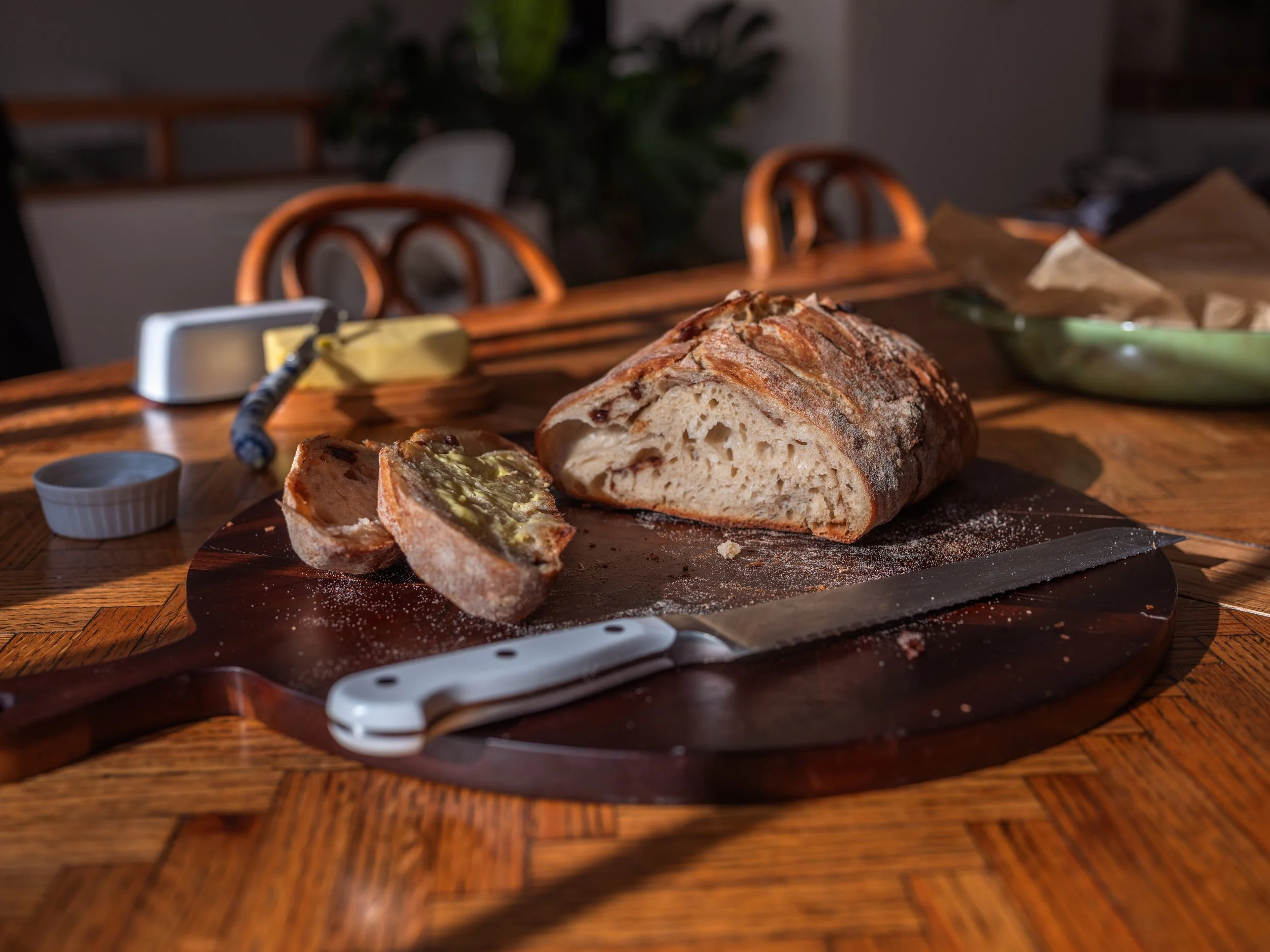
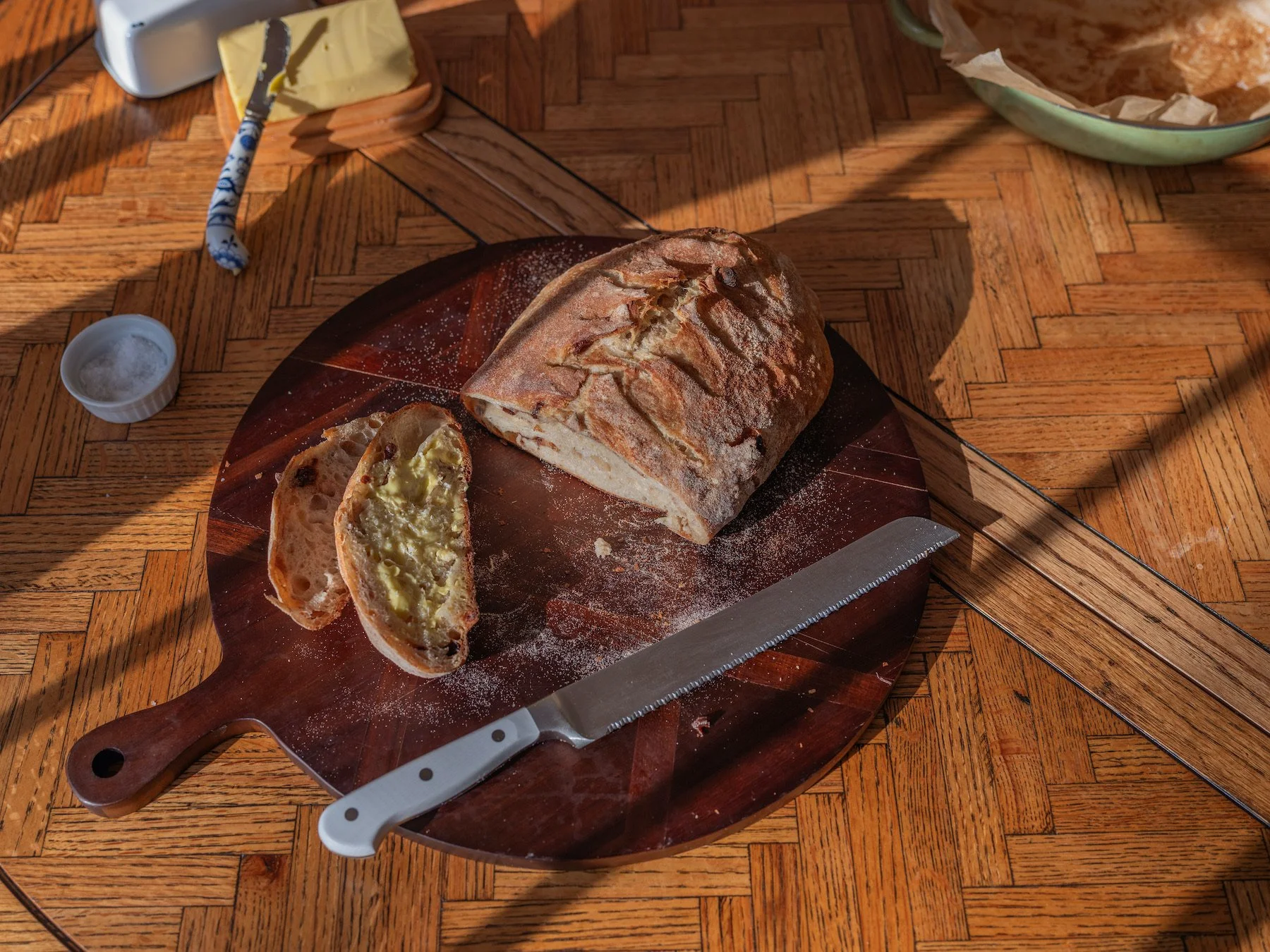
This is the loaf that usually waits on our table — sometimes sliced neatly, more often torn into before it has properly cooled. It’s the bread I referenced in The Culture of a Table, the one that seems to appear whenever people gather.
⸻
Ingredients
(Makes two loaves)
Leaven
200 g warm water
200 g bread flour
1 tablespoon active sourdough starter
Dough
700 g warm water
200 g leaven
900 g bread flour
100 g whole wheat flour
20 g fine sea salt
⸻
The Night Before
In a bowl, stir together the starter, warm water, and bread flour for the leaven.
Cover loosely and leave at room temperature overnight.
By morning it should look airy and full of bubbles.
⸻
In the Morning
In a large bowl combine:
700 g warm water
200 g leaven
Stir gently to dissolve the leaven in the water.
Add the bread flour and whole wheat flour. Mix until no dry bits remain and a rough dough forms. Cover and let rest for 30 minutes.
⸻
Add the Salt
Sprinkle the salt over the dough and add a small splash of warm water.
Work it in by squeezing and folding the dough until the salt disappears into it.
⸻
Bulk Fermentation
Let the dough rise at room temperature for 3–4 hours.
During the first two hours, give the dough a fold every 30 minutes:
Lift one side of the dough and fold it back over itself. Turn the bowl and repeat until you’ve gone all the way around.
With each fold the dough will become smoother and stronger.
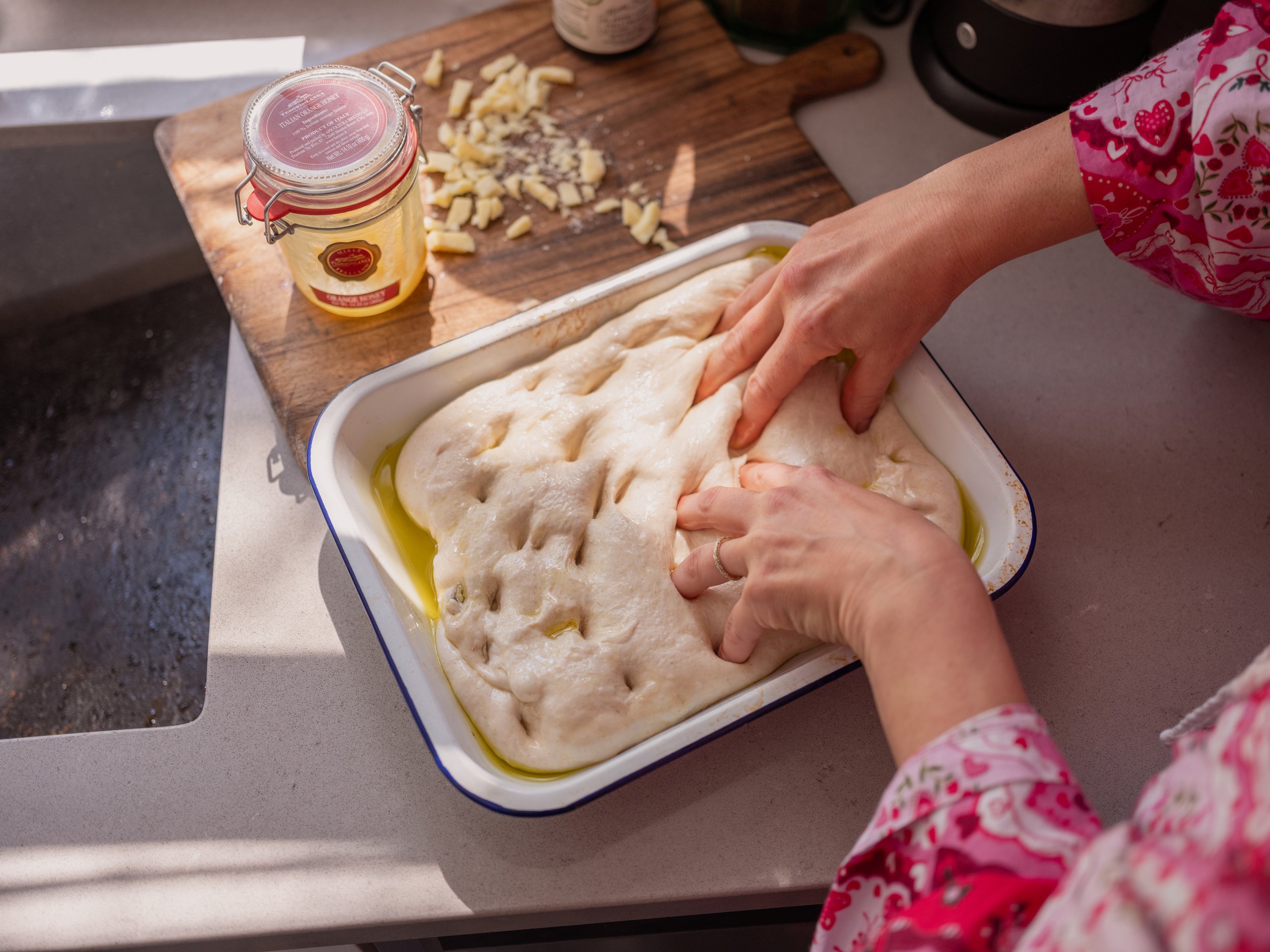
At this point, the dough could be just as easily become focaccia— pressed into a pan, dimpled with oil, and whatever the season calls for.
⸻
Divide and Rest
Turn the dough out onto a lightly floured surface.
Divide it into two pieces and shape each into a loose round. Let them rest for 20–30 minutes.
⸻
Shape
Shape the dough into rounds or long loaves and place them seam-side up into well-floured bannetons, or bowls lined with floured kitchen towels.
⸻
Final Rise
Let the loaves rise for 3–4 hours at room temperature,
or refrigerate overnight for a slower rise and deeper flavor.
⸻
Bake
Place a Dutch oven in the oven and preheat to 500°F.
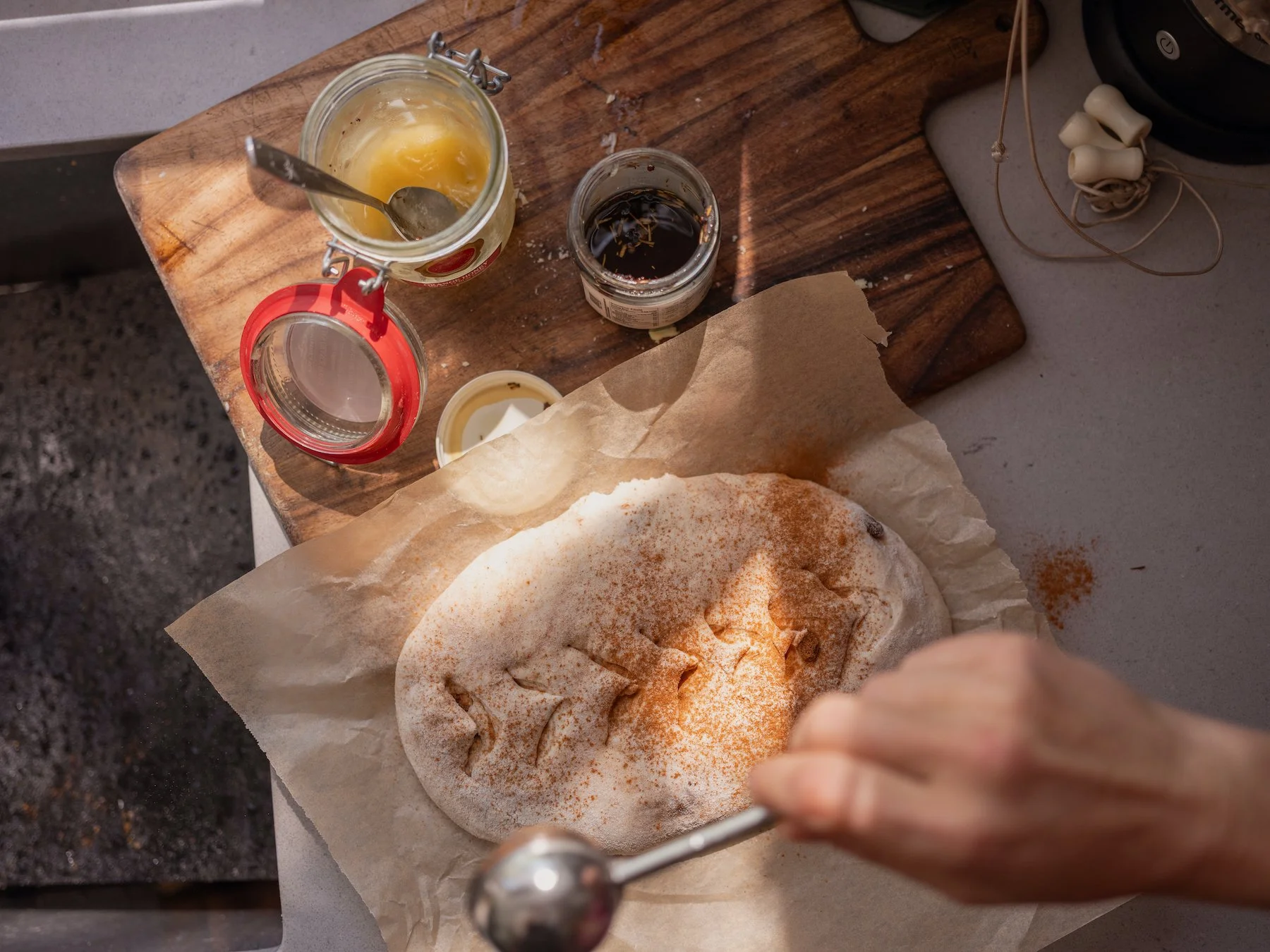
Turn a loaf onto parchment and score the top.
Bake:
20 minutes covered
20–25 minutes uncovered at 450°F
The crust should be deeply golden and sound hollow when tapped.
Let the loaf cool before slicing — though in our kitchen it is usually torn into long before that.
⸻
From the Kitchen
This is the bread we make most often.
It shows up beside soups, under soft eggs in the morning, and in thick slices the next day for toast.
More often than not, it arrives at the table still warm.
Pantry: The Mother
More than a recipe, she’s a quiet member of the household.
We call our sourdough starter The Mother because, one way or another, she ends up taking care of all of us.
Every loaf, pancake, focaccia, pizza dough, cracker, and cinnamon roll begins here. She’s less a recipe than a quiet member of the household—fed, neglected occasionally, forgiven often, and always ready to begin again.
Like most things around here, she’s meant to serve our life—not become another thing for us to serve.
Before We Begin
A sourdough starter is nothing more than flour and water.
And yet, given a little time, it becomes something entirely different.
Wild yeast and beneficial bacteria—already drifting through the air, resting on the grain, and quietly existing all around us—settle into that simple mixture and begin doing what they’ve always done. They ferment.
The flour becomes food.
The microorganisms multiply.
Tiny bubbles begin to appear.
What looked like an ordinary jar of paste slowly becomes alive.
Fermentation has always felt like one of those everyday miracles. Not because it’s magic, but because so much of it happens while you’re busy living your life somewhere else. You feed it, walk away, and return to discover that something has been quietly happening all along.
Maybe that’s why I love it so much.
It reminds me that some of the best things in a home are never rushed. They simply need the right conditions and a little patience.
⸻
Starting Your Mother
Day One
In a clean glass jar, mix:
50g whole wheat flour
50g bread flour
100g filtered water
Stir until no dry flour remains. Loosely cover the jar and leave it at room temperature for 24 hours.
Nothing exciting will happen yet.
That’s okay.
Day Two
You may notice a few bubbles. You may notice absolutely nothing.
Discard about half the mixture.
Feed it with:
50g whole wheat flour
50g bread flour
100g filtered water
Stir, cover loosely, and leave it another 24 hours.
Days Three Through Six
Repeat the same process each day.
Discard about half.
Feed with fresh flour and water.
Some days it will seem incredibly active. Other days it may appear to do nothing at all. Around the middle of the week, many starters seem to “die.” They haven’t. One community of bacteria is giving way to another, and the culture is simply finding its balance.
Keep feeding it.
Trust the process.
Around Day Seven
One morning you’ll come back to find it has doubled in size, full of bubbles and smelling pleasantly tangy.
Congratulations.
You’ve just made friends with a colony of wild yeast.
⸻
Caring for The Mother
Once she’s active, I keep her in the refrigerator.
The day before I want to bake, I feed her, leave her on the counter until she’s lively and bubbly again, then she’s ready for bread, pancakes, focaccia, or whatever we’re making that week.
If life gets busy and she’s forgotten for a while, I don’t panic. A couple of feedings is usually all she needs to find herself again.
Around here, she’s resilient.
⸻
From My Pantry
I almost never throw discard away. Pancakes, crackers, waffles, muffins, biscuits, pizza dough—it nearly always finds another purpose.
Don’t become a servant to your starter. Let it support your life, not the other way around.
The Mother has a way of quietly taking care of everyone in the house.
⸻
One last thing.
Truthfully, you could skip this entire process.
Find someone who bakes sourdough and casually ask if they have any starter to spare. Watch how quickly they disappear into the kitchen before returning with a little container of bubbling starter like they’re participating in the world’s friendliest drug deal.
They’ll probably even tell you her name.
⸻
From My Pantry
If she seems quiet, don’t give up on her. She usually just needs dinner and a good night’s sleep.